Start with the job. The agent handles the workflow.
No special prompt is required. Type @ in Codex or / in Claude Code, start typing the agent name, and wait for autocomplete. Press Enter once to load it and Enter again to start; then choose a menu number. The agent will name the strongest default product before intake. Use the power examples below when you want to see how far a route can go.
The agent should expand your ambition, not hand you a blank page.
A number-only selection is enough. Productive routes immediately name the product and first gate; Help routes ask one to three plain-language questions and then recommend one route.
Launch the agent and choose a menu number. The product should not depend on you knowing the right report name or writing style.
Power-user start
Supply scope, intended use, constraints, and the decision boundary. The agent reuses that context and moves directly to the next legitimate gate.
What the experience looks like
Start small, then see the ceiling.
Each pair begins after the intended agent is selected. The ordinary request is enough to start; the power request demonstrates the product’s upper range without bypassing approval gates.
01 / GovCon Growth Agent
Opportunity and competitive intelligence
Start with the growth objective and enough company context to make the public evidence useful.
Ordinary start
Help me find and evaluate federal growth opportunities for a small cybersecurity firm.
Power request
Build a sourced shortlist of civilian-agency set-aside opportunities closing 30 to 120 days from now for a small SDVOSB offering zero-trust implementation, cloud security engineering, and continuous authorization support. Target $1 million to $20 million opportunities, separate public fit evidence from internal gaps, and produce an evidence screen for the strongest candidates without making the bid decision.
What happens next
The complete nine-mode menu appears before research begins.
The agent asks only for internal context relevant to the selected mode.
It presents the research plan and sanitized public terms for approval.
You stay in control
You choose the public-web provider path or no-public-web mode.
Private and procurement-sensitive information stays out of public search.
A bid recommendation requires your internal company context.
What you get: evidence-linked chat findings or an optional validated GovCon Growth Brief.
Start with the acquisition need. The agent can handle scope only, pricing only, or the complete approved handoff.
Ordinary start
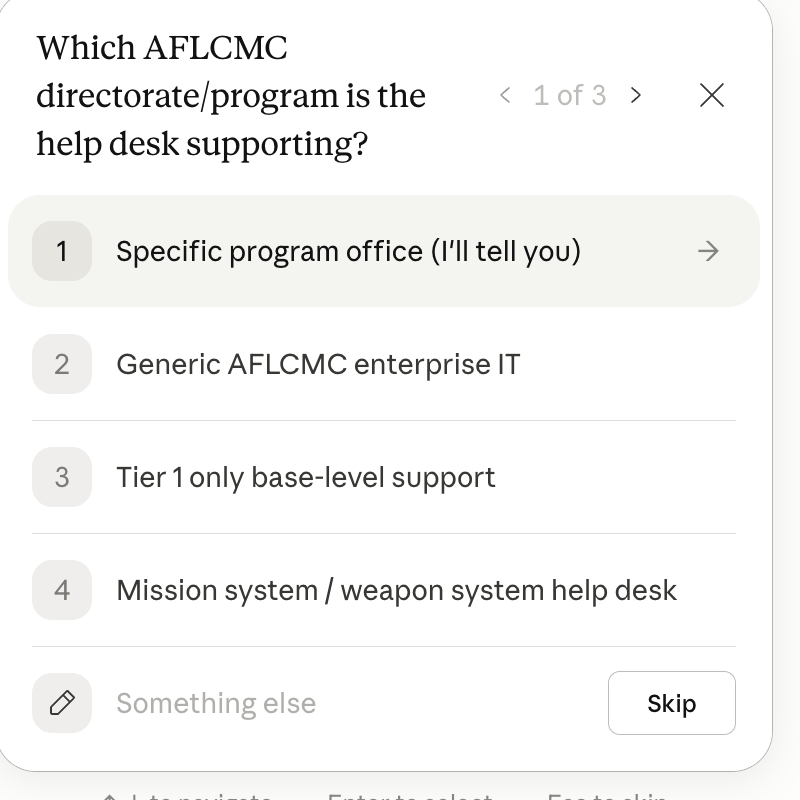
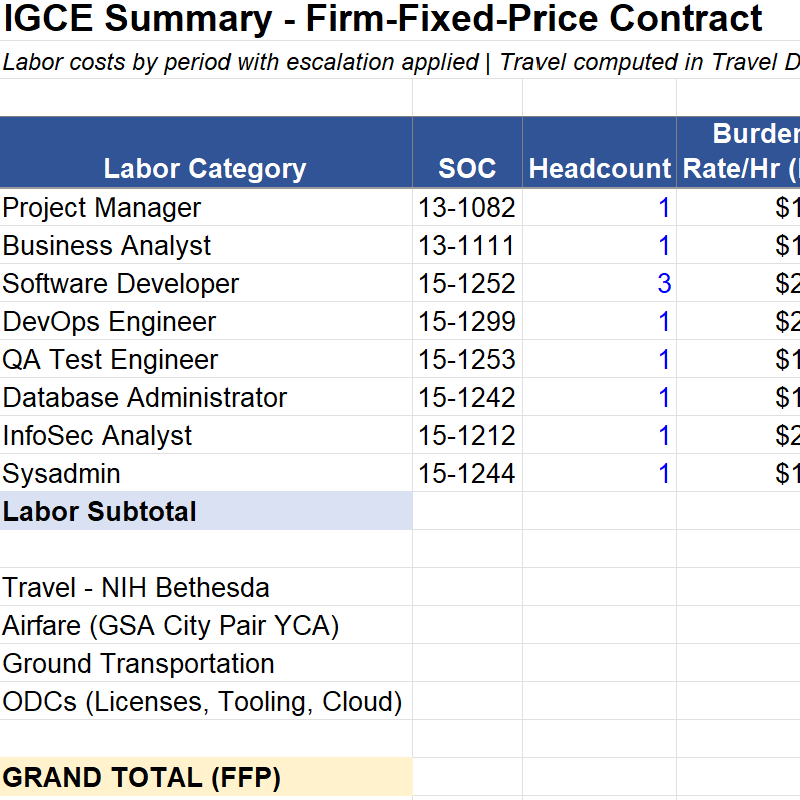
Help me create a performance work statement and associated IGCE for a help desk support requirement.
Power request
Build a PWS and firm-fixed-price IGCE for a 24/7 Tier 1 and Tier 2 service desk supporting 8,000 users by phone, portal, and chat. Use a one-year base and four option years, a Washington, DC labor market, primarily remote performance, and limited transition travel. Keep staffing and Section B handoffs outside the PWS, show assumptions and scenarios in the workbook, and preserve every scope and pricing approval.
What happens next
The agent frames the requirement and confirms SOW or PWS.
It develops measurable scope and validates the document.
After approval, it routes to the user-selected pricing method.
You stay in control
You approve the scope before pricing begins.
You or the Contracting Officer selects the contract type.
Documents and workbooks remain separate artifacts.
What you get: a validated PWS .docx and a separate, auditable IGCE .xlsx.
Start with the project objective. The agent preserves the approved milestone handoff into cost analysis.
Ordinary start
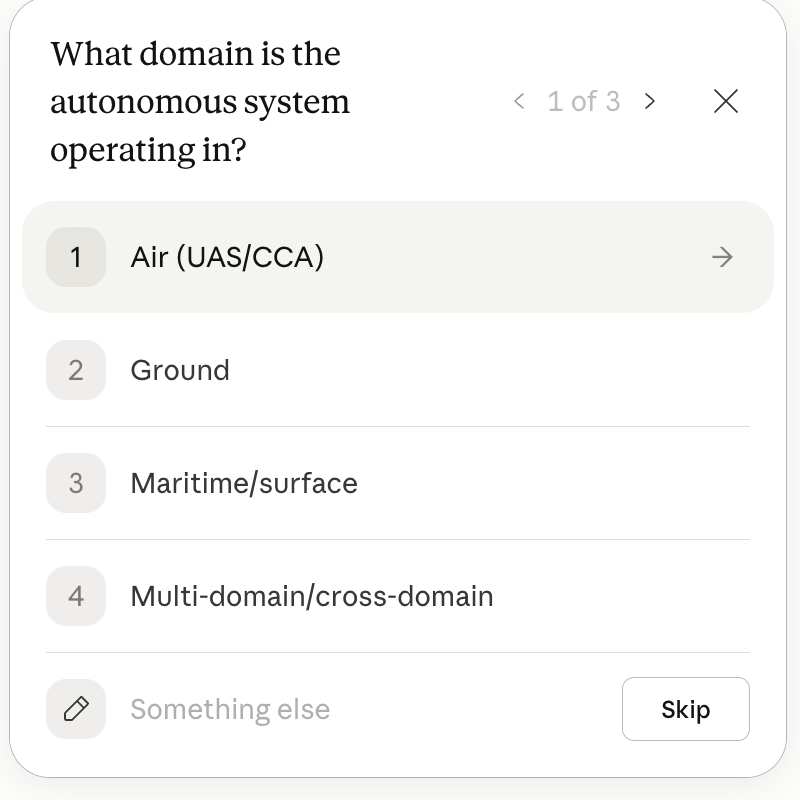
Help me develop and cost a prototype Other Transaction for an autonomous inspection system.
Power request
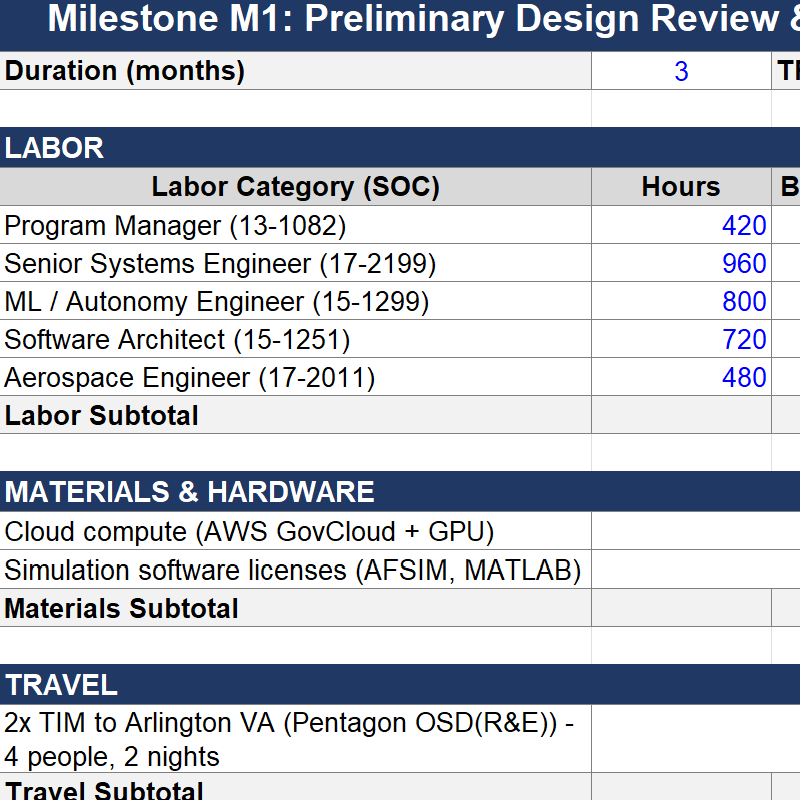
Build a Prototype OT project description and milestone cost analysis for an autonomous facility-inspection system demonstrated at three government sites over 18 months. The Agreements Officer confirmed the 10 U.S.C. 4022 Path A basis; keep the current baseline, contribution terms, data rights, payment types, and staffing pending; separate the project-description .docx from the cost .xlsx; and carry only the approved milestone handoff forward.
What happens next
The agent confirms the user-selected OT pathway and project framing.
It builds objectives, milestones, deliverables, and go/no-go gates.
After approval, it asks permission to transition into cost analysis.
You stay in control
An authorized official confirms authority and reserved determinations.
You approve the project description before it is costed.
The scope and cost artifacts remain separate.
What you get: a validated milestone project-description .docx and separate cost-analysis .xlsx.